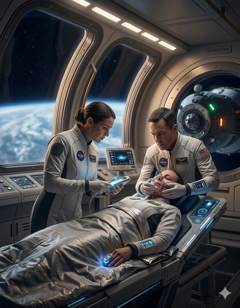
In the silent vacuum above Earth, where precision and calm are the difference between life and death, even the smallest medical emergency can spiral into catastrophe.
Now, a chilling account from a NASA astronaut has revealed how a sudden and terrifying 20-minute medical crisis aboard the International Space Station forced space agencies into a rare — and historic — emergency evacuation.
A Crisis in Orbit
According to the astronaut’s account, what began as a routine mission quickly turned into a race against time when a crew member experienced a rapid and severe medical episode.
Symptoms escalated within minutes.
With no hospital, no specialist equipment, and Earth hundreds of miles below, the crew had to rely on limited onboard medical training and supplies — all while maintaining control of one of humanity’s most complex machines.
For 20 tense minutes, the situation hung in the balance.
Why Space Changes Everything
Medical emergencies in space aren’t like those on Earth.
Microgravity alters how blood flows, how organs behave, and even how medications work. A condition that might be manageable on the ground can become unpredictable — even fatal — in orbit.
That reality forced mission control into a stark decision.
The Call to Evacuate
Flight surgeons and engineers at NASA made the rare call: prepare for emergency evacuation.
A spacecraft docked to the ISS — always kept ready as a lifeboat — suddenly became the crew’s only way out.
Evacuations from the station are extraordinarily uncommon. Each one carries enormous risk, cost, and global attention.
But this time, there was no alternative.
The Human Factor
Despite the pressure, the astronaut described how training, discipline, and teamwork took over.
Every movement was deliberate. Every decision calculated.
Inside that confined orbital lab, the crew faced the ultimate test — not of technology, but of human resilience.
A Historic Moment in Spaceflight
The incident has now entered the record as one of the most intense medical emergencies ever disclosed aboard the International Space Station.
It serves as a stark reminder:
As humanity prepares for longer missions — to the Moon, Mars, and beyond — the greatest unknown may not be space itself… but how the human body copes with it.
Final Word
Space exploration is often portrayed as a triumph of engineering.
But sometimes, the real story is far more fragile.
A heartbeat.
A breath.
And 20 minutes that could have changed everything.