By Publisher Ray Carmen
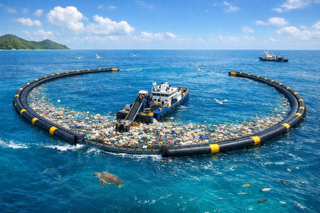
In an age when the world’s oceans are increasingly burdened with plastic waste and floating debris, scientists and environmental engineers have unveiled an elegant yet powerful solution: a U-shaped floating barrier designed to collect trash directly from the water.
The concept is simple, but the implications are enormous.
The barrier, which floats on the ocean’s surface in a wide U-shaped curve, works with the natural movement of the sea rather than against it. Ocean currents gently push floating debris toward the centre of the U, where the trash becomes concentrated and can be easily collected and removed.
Unlike traditional cleanup methods that rely on ships chasing debris across vast stretches of water, the floating system essentially lets the ocean do the work. As currents move through the barrier, plastics and other waste drift into the collection zone while marine life is able to swim safely underneath the structure.
How It Works
The floating device operates through three key principles:
1. Passive collection
The barrier sits on the surface and moves slowly with currents. Because it travels slightly slower than the surrounding water, debris naturally gathers inside the curve.
2. Natural current guidance
Ocean currents guide floating plastics into the centre of the U-shape, concentrating waste that would otherwise remain scattered across large areas.
3. Periodic removal
Support vessels periodically collect the accumulated trash, transporting it back to shore where it can be sorted, recycled, or safely disposed of.
A Potential Game-Changer
With millions of tonnes of plastic entering the oceans each year, innovations like this could represent a major turning point in the fight against marine pollution.
Large floating systems using this principle are already being tested in some of the most polluted regions of the world’s oceans, including areas known as “garbage patches”, where circulating currents trap enormous amounts of debris.
If scaled successfully, the technology could remove vast quantities of floating waste while operating with relatively low energy use and minimal disruption to marine ecosystems.
A Cleaner Future
The U-shaped barrier reminds us that sometimes the most powerful solutions come from working with nature rather than against it.
As engineers refine the design and deploy larger systems across the seas, the dream of cleaner oceans may move from aspiration to reality.
For a planet whose waters sustain life, food systems and entire coastal economies — including those across the Caribbean — that is welcome news indeed.