
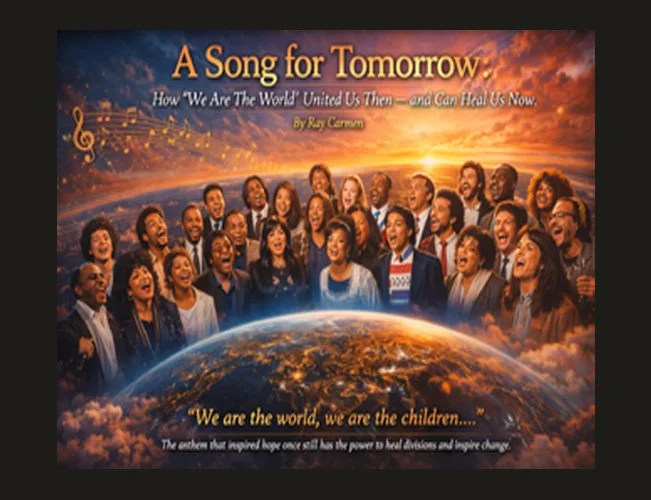
A SONG FOR TOMORROW : HOW ‘WE ARE THE WORLD‘ UNITED US THEN AND CAN HEAL US NOW
By Publisher Ray Carmen
The world in 2026 feels restless.
Nations are louder, politics sharper, alliances strained, and public discourse increasingly shaped by fear, speed, and spectacle. Trust in institutions wavers. Empathy often loses ground to outrage. People talk past one another rather than to one another.
And yet , in moments like this , history has a way of whispering back.
Sometimes, it does so through a song.
In 1985, “We Are the World” arrived not as protest or propaganda, but as a rare act of collective conscience. At a time of Cold War tension, global inequality, and ideological division, it chose unity over rhetoric and compassion over power.
Four decades on, its message feels uncannily current.
A World Once Again at a Crossroads
The political climate of 2026 is defined less by single events than by atmosphere. Across continents, leadership is increasingly personalised, debates polarised, and societies pulled into opposing camps. Social media accelerates anger. Algorithms reward division. Nuance struggles to survive.
In such a landscape, the danger is not disagreement , it is dehumanisation.
This is where “We Are the World” quietly re-enters the conversation.
Not as nostalgia, but as reminder.
What the Song Understood , and Politics Often Forgets
Written by Michael Jackson and Lionel Richie, and guided by Quincy Jones, the song was revolutionary precisely because it rejected ego. The world’s most powerful voices did not compete ,they blended.
No one stood above the message.
No ideology claimed ownership.
No nation asserted dominance.
“There comes a time when we heed a certain call…”
That call was moral, not political. It recognised that leadership without empathy is hollow — and that progress without unity is fragile.
In 2026, this lesson feels vital.
Beyond Leaders, Back to Humanity
Political cycles rise and fall. Figures come and go. History will debate them long after headlines fade. But the deeper question remains constant:
How do people treat one another when the world feels uncertain?
“We Are the World” offers an answer that transcends left and right, East and West. It reminds us that cooperation is not weakness, that compassion is not surrender, and that caring for others is not idealism , it is survival.
“We’re saving our own lives…”
In a fractured global climate, that line lands with renewed force. It speaks to the truth that division ultimately harms everyone — economically, socially, and spiritually.
Why This Message Resonates in 2026
Today’s challenges are global by nature:
Climate instability
Migration and displacement
Economic inequality
Technological disruption
Cultural polarisation