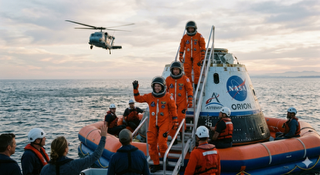
In a moment that will echo through the annals of human achievement, the crew of Artemis program has returned safely to Earth after completing one of the most ambitious lunar missions in modern history.
Launched under the banner of NASA’s bold new era of space exploration, the mission marks a decisive step forward in humanity’s long-awaited return to the Moon—more than half a century after the iconic Apollo 11 Moon Landing.
A Mission That Redefines the Possible
The Artemis crew’s journey was not just a symbolic return—it was a technological and scientific triumph. Travelling aboard the powerful Orion spacecraft, astronauts ventured farther than any human mission in decades, testing systems that will pave the way for sustained lunar presence—and ultimately, missions to Mars.
From precision navigation in deep space to the safe re-entry through Earth’s atmosphere, every phase of the mission demonstrated the extraordinary evolution of spaceflight capability.
Why This Moment Matters
Unlike the Apollo era, Artemis is not about planting a flag and leaving. It is about staying.
The mission lays the groundwork for future lunar bases, international cooperation, and a new space economy. It also signals a shift in ambition—from exploration to habitation.
With partners across the globe contributing to the programme, Artemis represents a shared human vision—one that extends beyond borders and generations.
A New Chapter for Humanity
The safe return of the crew is more than just the end of a mission—it is the beginning of a new chapter.
As humanity looks once again toward the Moon, the Artemis programme is not merely revisiting history—it is rewriting the future.
And this time, we are not just going back.
We are going forward—together.
Final Word
From the silence of space to the roar of Earth’s atmosphere, the Artemis crew’s journey reminds us of one simple truth: the frontier is still out there—and humanity is still bold enough to chase it.