
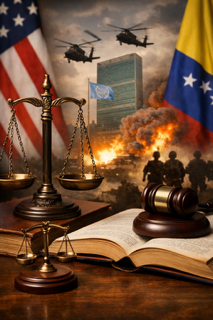
This Act Will Have Severe and Enormous Repercussions Across the World, A Legal Examination of a Dangerous Global Precedent
By Publisher Ray Carmen
History does not always arrive with ceremony.
Sometimes it breaks in the dead of night — through reports of military action, arrests, and unilateral decisions that test the very foundations of international order.
In the opening days of 2026, the world awoke to extraordinary reports concerning a United States operation involving Venezuela — an action that, if carried out as described, raises one overriding question that transcends politics, ideology, and personality:
Was it legal?
This article does not debate whether Venezuela’s leadership is popular or unpopular.
It does not weigh political preferences or moral justifications.
It examines something far more consequential: whether a powerful state can lawfully use force inside another sovereign nation without international authorisation — and what it means for the rest of the world if it can.
The Bedrock of International Law: Sovereignty
The modern international legal system rests on a principle forged from the ashes of the Second World War: state sovereignty.
Under Article 2(4) of the United Nations Charter, the threat or use of force against the territorial integrity or political independence of any state is prohibited, except in two narrowly defined circumstances:
Self-defence in response to an armed attack, or
Explicit authorisation by the United Nations Security Council
These are not optional guidelines. They are the legal pillars designed to prevent global chaos.
Absent either condition, military intervention — including the seizure, removal, or detention of a sitting head of state — is widely regarded as unlawful under international law.
Is There a Lawful Justification?
As of this writing, no publicly available evidence confirms:
A United Nations Security Council resolution authorising the use of force
An imminent armed attack on the United States by Venezuela
A mandate issued by an internationally recognised tribunal
If these conditions are not met, the action risks qualifying as an act of aggression under international legal standards.
The Rome Statute of the International Criminal Court, while not recognised by all states, defines aggression as the use of armed force by one state against the sovereignty or political independence of another. This definition reflects broad international consensus and continues to shape how legality is assessed worldwide.
Why This Matters Beyond Venezuela
If one nation can:
Enter another sovereign state
Remove or detain its leadership
Justify the act unilaterally