
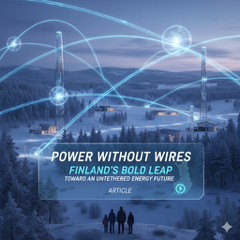
Power Without Wires: Finland’s Bold Leap Toward an Untethered Energy Future
By Publisher Ray Carmen
In a quiet laboratory far from the noise of Silicon Valley, Finland may have just nudged humanity one step closer to a world without plugs, cables, or power lines.
According to reports circulating this week, Finnish researchers have successfully transmitted electrical power through the air — without the use of physical wires. While the idea may sound like science fiction, it is rooted in serious science, and it could one day transform how the world powers everything from smartphones to satellites.
How Does Wireless Power Actually Work?
The concept isn’t entirely new. Nikola Tesla famously dreamed of wireless electricity more than a century ago. What Finland appears to have demonstrated, however, is a controlled and efficient modern version of that dream.
Using advanced electromagnetic fields and resonant coupling techniques, energy can be transmitted from a source to a receiver through open air — without metal cables connecting the two. Think of it as Wi-Fi, but for electricity.
The receiver converts the transmitted energy back into usable electrical power, enough to operate devices or recharge batteries — all without being physically plugged in.
Why Finland, and Why Now?
Finland has quietly become one of Europe’s most advanced innovation hubs, particularly in clean energy, telecommunications, and applied physics. The country’s deep expertise in radio technology — honed by decades of leadership in mobile communications — makes it uniquely positioned to push wireless power from theory into reality.
Crucially, this breakthrough aligns with Finland’s wider ambition to create energy-efficient, low-carbon systems that reduce dependence on heavy infrastructure.
What This Could Mean for the World
If scaled safely and efficiently, wireless power transmission could reshape daily life:
Cities without overhead power lines
Remote communities powered without expensive grid infrastructure
Electric vehicles charging while parked — or even in motion
Medical implants powered without surgeries to replace batteries
Drones, sensors, and satellites operating longer and more reliably