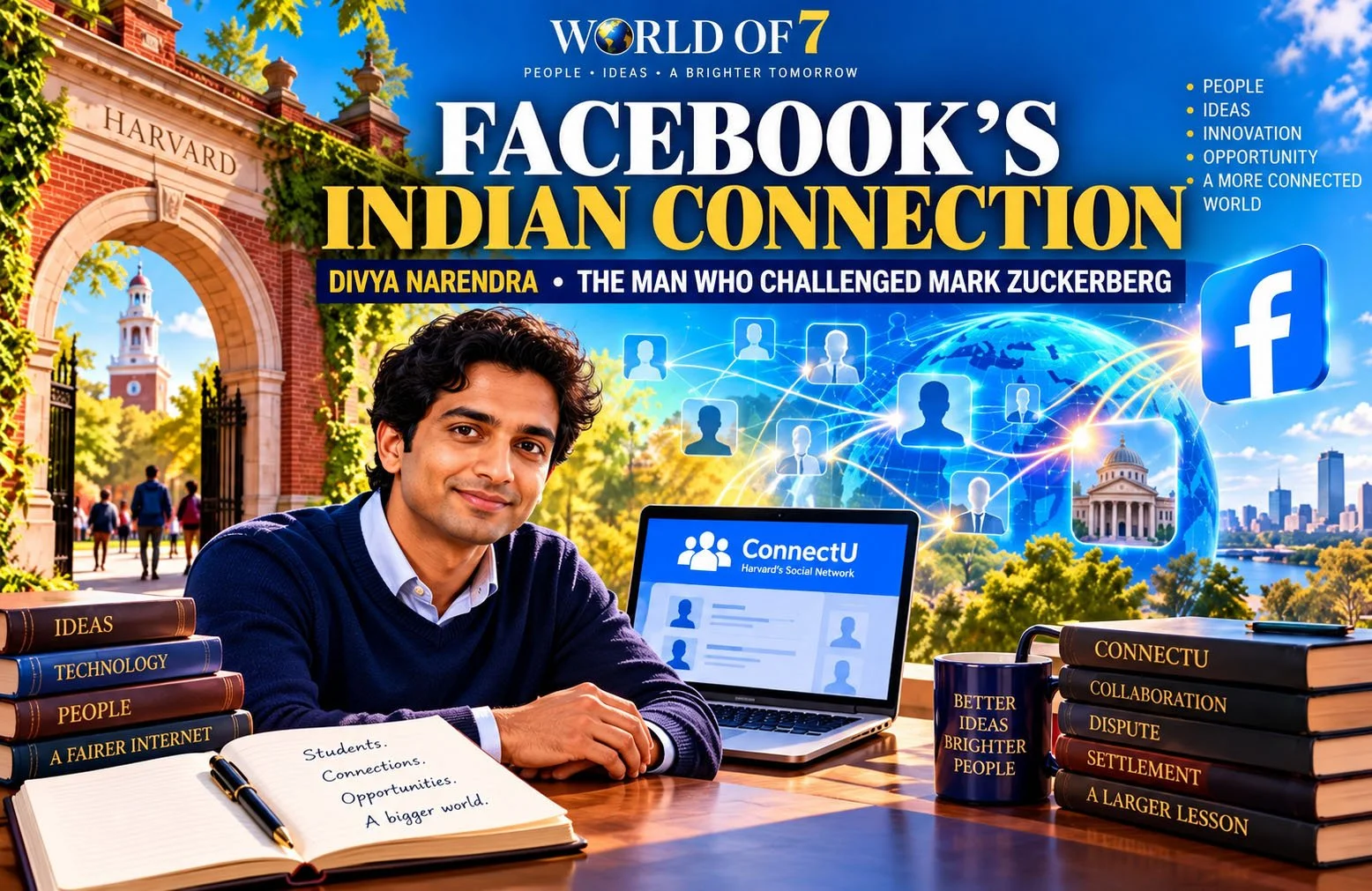
THE MAN WHO CHALLENGED MARK ZUCKERBERG
By Publisher Ray Carmen
THE STORY BEHIND THE VIRAL CLAIM The Indian-American entrepreneur Divya Narendra was central to a Harvard social-networking venture that became Facebook’s most famous early rival. But he was not a founder of Facebook, and the celebrated dispute did not prove that Facebook was stolen.
A Harvard idea before the social-media explosion
Long before Facebook became a global force, three Harvard undergraduates were imagining an online community that would help students meet, identify and communicate with one another. Divya Narendra, the American-born son of Indian immigrant doctors, joined forces with twins Cameron and Tyler Winklevoss to develop a campus-networking service first called HarvardConnection and later ConnectU.
Their project was conceived as early as 2002. They approached student programmer Mark Zuckerberg in 2003 to help complete the website. Narendra and the twins later alleged that Zuckerberg delayed work on their venture while building a competing social network. Their account became one of Silicon Valley’s best-known founding disputes.
What actually happened to Facebook?
On 4 February 2004, Zuckerberg and fellow Harvard students launched TheFacebook. Meta’s own company history identifies Zuckerberg, Dustin Moskovitz, Chris Hughes and Eduardo Saverin as the launch co-founders. ConnectU went live later that year, and Narendra’s group brought legal claims alleging misuse of their concept and related intellectual property.
The founders’ claims were fiercely disputed. In 2008, the parties reached a settlement valued at approximately US$65 million in cash and Facebook stock, a sum publicly reported in 2009. That settlement ended the controversy commercially; it was not a judicial finding that Zuckerberg had stolen the idea or code. Facebook’s spectacular success, moreover, cannot be attributed to one student or one invention alone.
The Indian-American name behind the headlines
The popular Instagram formulation — “not Zuckerberg but an Indian was the brain behind Facebook” — is therefore too absolute. Narendra was a co-creator of an important earlier rival concept and a principal figure in the dispute over Facebook’s origins. He was not the person who launched Facebook, and it would be misleading to assign its entire invention to him.
His background nevertheless deserves recognition. Raised in Queens, New York, by parents who had immigrated from India, Narendra brought ambition and entrepreneurial imagination to Harvard. In an interview published by The Harvard Crimson in February 2026, he recalled the creative atmosphere of the university and the value of meeting talented collaborators. The 2010 film The Social Network introduced his part in the story to a wider audience, but the cinematic portrayal should not be mistaken for a complete biography.
Beyond Facebook: building SumZero
Narendra’s career did not end with the lawsuit. After working in finance, he founded SumZero in 2008, creating a professional network where investment specialists exchange research and ideas. The platform shows a revealing continuity: his entrepreneurial interests again centred on bringing a defined community together and giving its members tools to share knowledge.
The Crimson’s 2026 profile also describes his subsequent investment venture, SumZero Capital, and his interest in machine learning. Rather than remain defined by a legal battle from his twenties, he has continued to build businesses at the intersection of technology, networking and finance.
The lesson for tomorrow’s innovators
Few technology stories have a single author. There is the person who imagines a concept, the team that builds a product, the entrepreneur who scales it and the investors and users who determine its future. HarvardConnection, ConnectU and Facebook sit at the intersection of those roles.
The Indian connection to Facebook’s story is real and historically significant — not because the record supports replacing Zuckerberg with one different “true inventor”, but because Divya Narendra and his collaborators helped shape the contest of ideas around university social networking. Recognising their contribution makes the history richer, not less accurate.