
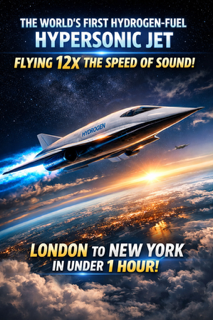
The Hydrogen Horizon: The Hypersonic Jet That Could Redefine Global Travel
By Publisher Ray Carmen
Imagine boarding a jet in London and stepping out in New York less than an hour later. No sonic boom delays. No carbon guilt. Just pure, silent velocity at the edge of space.
That future may be closer than we think.
A new generation of aerospace engineers and visionaries is racing to build what could become the world’s first hydrogen-fuelled hypersonic jet — an aircraft capable of flying at up to Mach 12, or twelve times the speed of sound. If realised, it would shatter not just speed records, but the very limits of how humanity moves across the planet.
What Is Hypersonic Flight?
Hypersonic aircraft operate at speeds above Mach 5. At Mach 12, a jet would travel at nearly 15,000 km/h, skimming the upper atmosphere where air thins and the sky darkens toward space. At such velocities, friction heats the aircraft’s skin to extreme temperatures — one of the greatest engineering challenges ever attempted.
Why Hydrogen Changes Everything
Traditional jet fuel simply cannot survive these conditions. Hydrogen, however, offers a revolutionary alternative:
Ultra-clean combustion producing only water vapour
Extreme energy density, ideal for sustained hypersonic travel
Cryogenic cooling potential, helping manage heat at blistering speeds
Some proposed designs even use hydrogen not only as fuel, but as a coolant flowing through the aircraft’s skin, absorbing heat before ignition — a breathtaking fusion of propulsion and thermal engineering.
From Runway to the Edge of Space
Unlike rockets, these jets would take off from conventional runways. They would then climb rapidly, transitioning from jet engines to advanced scramjet propulsion, compressing incoming air at hypersonic speed without traditional turbines.
The result?
A seamless ascent into near-space flight — fast enough to cross continents in minutes, yet designed to land like a normal aircraft.
Civilian Travel, Military Power, or Both?
While the military implications are obvious — rapid global response, near-undetectable speed — the true long-term prize is civilian hypersonic travel.
London to Dubai: ~25 minutes
Paris to Sydney: under 2 hours
New York to Tokyo: about 60 minutes