
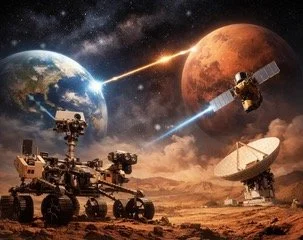
Linking Worlds Earth to Mars: How Robots Communicate Across the Void of Space
By Publisher Ray Carmen
For decades, science fiction imagined robots chatting freely across the Solar System. Today, that vision is no longer fantasy. Robots on Mars are communicating with Earth every single day — sending images, data, and discoveries across millions of kilometres of empty space. Yet this remarkable achievement comes with extraordinary challenges that redefine what communication truly means beyond our planet.
A Conversation Measured in Minutes, Not Seconds
Unlike communication on Earth, signals between Earth and Mars do not travel instantly. Radio waves and laser signals move at the speed of light, but even light takes time to cross the vast interplanetary distance.
Depending on where Earth and Mars sit in their orbits, messages take between 3 and 22 minutes one way. A simple command-and-response exchange can therefore take nearly three-quarters of an hour.
This delay means there can be no live conversation, no joystick control, and no instant troubleshooting. Mars robots must think for themselves.
How Mars Robots Actually Talk to Earth
Mars rovers such as Perseverance and Curiosity do not usually send data directly to Earth. Instead, they rely on a carefully choreographed relay system.
Step One: Surface to Orbit
The rover transmits its data to spacecraft orbiting Mars, including:
Mars Reconnaissance Orbiter (MRO)
MAVEN
These orbiters act as celestial postmen, storing and forwarding information.
Step Two: Mars to Earth
The orbiters then beam the data across space to Earth’s Deep Space Network (DSN) — a global array of giant antennas located in:
California
Spain
Australia
This worldwide network ensures that Earth can always receive signals as the planet rotates.
What Robots Can Send — and What They Can’t
Mars robots regularly transmit:
High‑resolution images
Scientific measurements
Weather and environmental data
Status and health reports
However, bandwidth is limited. There is no continuous video streaming, and every transmission must be compressed, prioritised, and scheduled with precision.
The Rise of Autonomous Intelligence on Mars
Because Earth cannot respond quickly, Mars robots operate with a high level of autonomy. They:
Navigate hazards on their own
Choose safe routes
Adjust instruments without human intervention
Artificial intelligence allows them to make decisions that once required human judgment. In effect, Mars robots are not remote‑controlled machines — they are independent explorers.
Laser Communication: The Next Giant Leap
Radio waves have carried Mars exploration this far, but the future lies in optical (laser) communication.
Laser systems can:
Transmit vastly more data
Use smaller antennas
Support future human missions
NASA has already demonstrated successful deep‑space laser communication, paving the way for high‑definition imagery, complex data streams, and eventually, interplanetary internet‑like systems.
Can Robots Talk to Each Other Across Planets?
Not in real time — but coordination is evolving.
Earth‑based AI systems send strategic instructions. Mars‑based robots execute missions and respond with results. In the future, networks of robots may collaborate locally on Mars while syncing periodically with Earth, forming the first interplanetary machine intelligence network.
Why This Matters for Humanity
Earth‑Mars communication is not just about robots. It is about preparing for:
Human missions to Mars
Permanent off‑world settlements
A future where humanity becomes a multi‑planet species