

Two Robots. Two Submarines. Millions of Miles Apart.
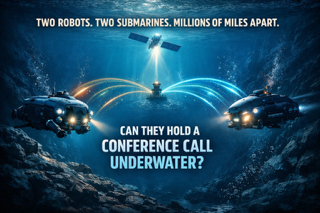
Can They Hold a Conference Call Underwater?**
By Publisher Ray Carmen
Far beneath the ocean’s surface, where sunlight never reaches and pressure can crush steel, two machines begin to “speak.”
One robotic submarine glides through the Atlantic abyss.
Another moves silently in the Pacific depths.
They are separated by half the planet — yet they are not alone.
So, can two robots, submerged deep underwater and millions of miles apart, actually communicate?
The answer is yes — but only by rewriting the rules of communication itself.
Why the Ocean Changes Everything
Underwater, the technologies we take for granted simply fail.
Radio waves vanish within metres.
Wi-Fi is useless.
Satellites are blind beneath the waves.
The deep ocean is one of the most hostile communication environments on Earth — darker, colder, and more isolating than space itself.
How Robots Speak Beneath the Waves
Instead of radio, underwater robots use sound.
Low-frequency acoustic signals travel far through water, just as whales have communicated across oceans for millennia. These signals are encoded into data pulses — slow, deliberate, and precise.
This isn’t Zoom or FaceTime.
It’s closer to an intelligent underwater telegraph.
The “Conference Call” Explained
Two robotic submarines cannot directly talk across oceans underwater — sound alone can’t carry that far with clarity.
But together, they can still communicate.
Here’s how the underwater conference call works:
Robot A sends acoustic data to a surface relay or buoy
The signal is transmitted via satellite or undersea fibre-optic cable
Robot B receives the message through its own relay
Artificial intelligence interprets the data and generates a response
The reply travels back down into the depths
To the robots, it feels like a conversation.
To humans, it’s a symphony of engineering.
The Role of Artificial Intelligence
This is where the future truly arrives.
AI allows underwater robots to:
Interpret fragmented or delayed messages
Decide when to respond without human input
Share maps, discoveries, and risk alerts
Operate independently for months at a time
In effect, two robotic submarines can “meet,” exchange knowledge, and collaborate — even while oceans apart.
Why This Technology Matters
This isn’t science fiction. It’s already in use today for:
Deep-sea exploration
Climate and seismic monitoring
Mapping the ocean floor
Energy infrastructure inspection
Search-and-rescue missions
Naval and security operations