

The Wars of Tomorrow: Futuristic Marine Warfare
By Publisher Ray Carmen
While the world’s attention is fixed on geopolitical flashpoints on land and in the skies, a far quieter — and far more consequential — transformation is unfolding beneath the waves.
The oceans are becoming the next great battlefield.
Not with fleets of warships or thunderous naval battles, but with machines, algorithms, and silent autonomy, operating far beyond human sight and, increasingly, beyond human control.
A New Age of Ocean Conflict
Traditional naval warfare is rapidly giving way to something more subtle and more dangerous.
Today’s most advanced maritime powers are investing heavily in:
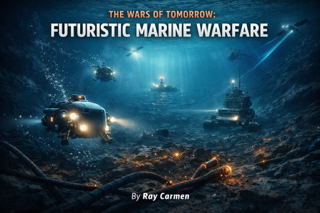
Autonomous underwater drones
AI-controlled submarines
Unmanned surface vessels
Robotic mine hunters
Sensor networks spread across the ocean floor
These machines do not sleep.
They do not fatigue.
And once deployed, they can operate for months — even years — without resurfacing.
The Silent War Beneath the Waves
Modern marine warfare may never make the evening news.
Instead of explosions and fireballs, future conflicts will be fought through:
Interference with undersea internet cables
Disruption of energy pipelines
Surveillance of shipping lanes
Shadowing rival submarines
Cyber and signal warfare conducted underwater
More than 95% of the world’s digital communications travel through cables laid across the seabed. In the modern era, the ocean floor is not just geography — it is global infrastructure.
Whoever controls it holds enormous power.
Why Humans Are Being Removed from the Equation
Human crews are vulnerable — politically, physically, and emotionally.
Machines are not.
Autonomous naval systems offer:
Zero risk to human life
Plausible deniability if lost or damaged
The ability to operate at crushing depths
Precision decision-making without hesitation
In a world desperate to apply pressure without triggering open war, robotic marine systems are the perfect instrument.
Artificial Intelligence Takes the Helm
At the heart of this transformation lies artificial intelligence.
AI allows marine systems to:
Track targets autonomously
Analyse patterns in real time
Share data across vast distances
Respond faster than any human crew